Quick Answer: What Results Can You Expect From SEO in 6 Months?
The Bottom Line:
SEO results in six months should include visible movement in search, keyword impression increases, technical website health, ranking movement on long-tail variations, and initial organic traffic gains. Your client should not expect a number one ranking for a competitive keyword phrase.
The speed of results depends on five primary variables:
- Domain Age & Existing Authority: Established sites move faster than brand-new domains.
- Technical Baseline: Fixing severe crawl errors can trigger rapid initial gains.
- Content Quality & Topical Depth: Comprehensive coverage accelerates indexation.
- Backlink Profile: Quality referring domains determine competitive headroom.
- Niche Competition: High-CPC, saturated markets take longer to penetrate.
Fast-tracking some sites will show SEO lead growth in less than 180 days. However, most sites (start ups or ultra-competitive markets) will not see meaningful revenue effects until they have put in about 6-12 months of SEO compound growth.
Table of Contents
SEO Is a Long-Term Investment, Not an Overnight Channel
Why There Is No Universal SEO Timeline (Case Comparison)
Concrete E-E-A-T Implementations for Commercial Sites
What Should Your SEO Agency Be Doing in Months 1–6?
Agency Red Flags: What Should Make You Question Your Provider?
How to Correctly Measure SEO Success (Metrics That Matter)
Frequently Asked Questions (FAQ)
SEO Is a Long-Term Investment, Not an Overnight Channel
Among the many myths surrounding search engine optimisation, one of the longest-lasting is the idea that small on-page changes should be rewarded immediately by Google.
Organic search works nothing like paid media. Search engines first need to discover new (or updated) pages and crawl their render trees, understand topical context, reason about entities, determine trust based on backlinks, test user engagement signals, and benchmark against current competitors (who are also doing many of the above things).
“How long does SEO take?” is a meaningless question if you don’t first inspect the site’s history. It’s the same as asking “How long does it take to build a house?” without seeing if they’ve laid the foundation yet.
Simultaneously, your competitors are actively optimizing their digital footprint:
- Publishing original, high-value content
- Earning editorial backlinks and brand mentions
- Expanding their structured product and service data
- Enhancers for user experience and Core Web Vitals
SEO is not a sprint against a static algorithm—it is a live, dynamic competition. The first six months are designed to establish the structural and authoritative groundwork required for continuous, compounding growth.
Why There Is No Universal SEO Timeline (Case Comparison)
To understand why timelines vary so dramatically, consider how starting baselines dictate early velocity:
| Site Parameter | Business A: Established Site | Business B: Brand-New Domain |
| Domain History | 8 Years Online | < 3 Months Online |
| Existing Authority | High (Hundreds of referring domains) | Low / Zero (No backlink history) |
| Technical Baseline | Poor internal linking, outdated metadata | Clean setup, but unindexed pages |
| Primary Bottleneck | Content gaps & technical debt | Lack of domain trust & brand entity signals |
| Realistic 6-Month Outcome | Rapid gains: 30%–70% increase in commercial traffic by optimizing existing authority. | Foundation gains: Keyword indexing, long-tail impressions, initial non-branded entry points. |
Month-by-Month SEO Roadmap: What Happens When
Month 1: Audit, Research & Strategy
Establishing the Evidence-Based Baseline
Month one is not measured by traffic spikes. It is measured by strategic clarity and issue discovery using tools like Google Search Console, Screaming Frog, Ahrefs, and Semrush.
- Technical Crawl Audit: Uncovering indexation blocks, duplicate paths, and site speed bottlenecks.
- Search Intent Mapping: Matching target keywords to primary commercial vs. informational landing pages.
- Topical Gap Analysis: Identifying where competitors hold context superior to yours.
- Analytics Calibration: Setting up accurate goal tracking, event measurement, and multi-channel attribution.
Month 2: Technical Fixes & On-Page Calibration
Eliminating Barriers to Indexation
With diagnostic data in hand, execution shifts toward fixing infrastructure and optimizing core commercial templates.
- Core On-Page Updates: Refining title tags, H1/H2 structures, canonicals, and meta descriptions.
- Architecture Overhaul: Streamlining internal link equity from high-authority pages to key category nodes.
- Commercial Page Depth: Enriching service and product category pages with structured specs, FAQs, and clear value propositions.
Month 3: Content Expansion & Topical Clusters
Building Information Gain & Depth
Month three shifts toward systematically building topical authority. Rather than spraying generic blog posts, content is deployed in structured “topical hubs.”
- Helpful Content Focus: Answering precise pre-purchase questions that demonstrate real expertise.
- Topical Linking: Connecting informational supporting posts directly back to primary conversion pages.
Month 4: Off-Page Authority & Backlink Acquisition
Earning Trust & External Validation
With high-quality landing pages active, campaigns focus heavily on earning off-page signals that search engines use to measure market authority.
- Digital PR & Guest Insights: Contributing genuine industry commentary to respected trade publications.
- Resource & Supplier Links: Securing high-relevance citations from industry partners and trade associations.
- Asset Promotion: Distributing original data, industry studies, or visual tools to earn organic references.
Month 5: Keyword Velocity & Data Refinement
Optimizing Striking-Distance Keywords
By month five, ranking shifts become pronounced. Pages frequently move from position 50+ into striking distance (positions 11–25).
- Page 2 Push: Identifying queries sitting on page two and boosting them via internal link adjustments and content refreshes.
- CTR Optimization: Polishing title tags and rich snippet markup for keywords generating high impressions but low clicks.
Month 6: Evaluation, ROI Analysis & Scaling
Measuring Progress Against Business Goals
Month six represents a major strategic checkpoint to evaluate lead quality, organic conversion paths, and channel growth.
- Conversion Attribution: Evaluating whether organic traffic is generating qualified leads, calls, or transactions.
- Data-Led Pivot: Double-down on high-performing content clusters while restructuring underperforming pages.
Concrete E-E-A-T Implementations for Commercial Sites
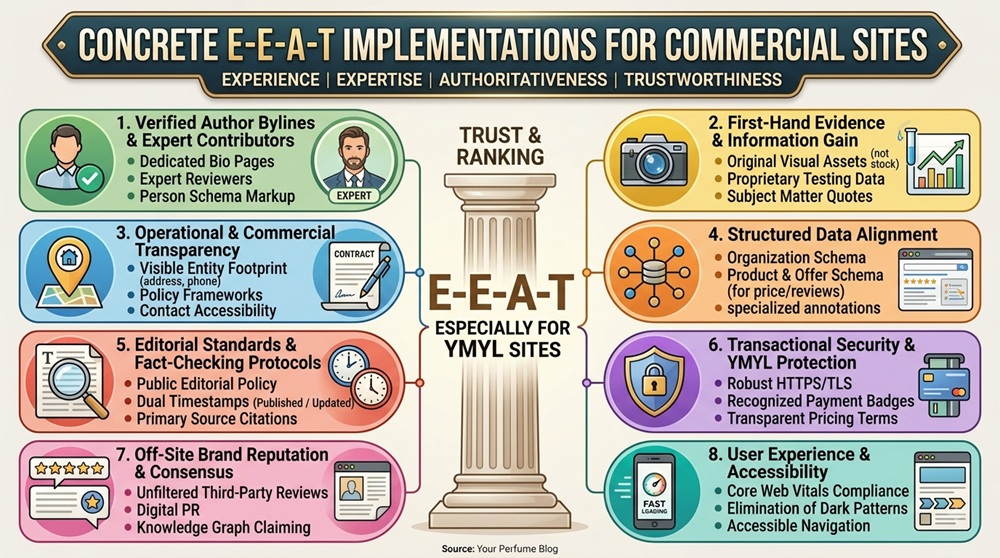
Google’s Quality Rater Guidelines make it clear that E-E-A-T is required to gain search trust, particularly on commercial and e-commerce websites where users are risking their money or personal information.
But how does that work in practice? Here are eight actionable ways to apply E-E-A-T directly on your website’s landing pages, category pages and supporting blog content:
1. Verified Author Bylines & Expert Contributor Networks
Commercial content often suffers from “anonymous brand voice” syndrome. To establish clear Expertise and Experience, every major transactional guide or commercial blog post should be tied to a verified human creator.
- Dedicated Bio Pages: Link every author byline to a dedicated bio page outlining their years in the industry, relevant degrees, certifications, and previous editorial features.
- Expert Reviewers: If content is written by an in-house copywriter, add an explicit “Fact-Checked / Reviewed By” tag linking to a recognized credentialed specialist.
- Structured Person Markup: Implement
Personschema markup containingsameAslinks pointing to the contributor’s active LinkedIn profile, social handles, and external published work.
2. First-Hand Evidence & Information Gain
Google loves content that provides Information Gain (not available from scraping the top 5 search results or lightly rewording them).
- Authentic Visual Content: Use original product photography, unboxing photos, bench-test images, or videos of products/services in action.
- Benchmark Results You’ve Personally Compiled: Share original specifications, stress test findings, or field performance data you’ve collected.
- Industry Expert Commentary: Include original thoughts, roundtable interviews, or trade organization viewpoints within your category pages and landing pages.
3. Operational & Commercial Transparency
Trustworthiness – Easily the core of E-E-A-T. Your site’s rankings will take a hit if crawlers and/or site visitors can’t readily ascertain who is behind your website.
- Visible Entity Footprint: Put your business’ registered name, address, phone numbers, and customer service email address right up front in your website footer.
- Indexed Policy Pages: Shipping Policy, Return & Refund Policy, Warranty Policy and Terms of Service should all be distinct landing pages on your site.
- Clickable Contact Links: Implement social chat pop-ups, contact us forms, and knowledge-based support centers on your primary product category pages.
4. Comprehensive Structured Data Alignment
Structured data tells search engines how your business, your employees, and your products/services relate to one another.
- Schema.org type: Organization: Use this markup to include your brand canonical names (aka “aliased entities”), logo image, parent organization, and social links.
- Schema.org type: Product, AggregateRating, Offer: Use these markups together to show availability, price, and REAL ratings on rich snippets.
- Medical, Tech Terms: Apply niche marksups such as reviewedBy, hasCredential, publishingPrinciples for YMYL topics.
5. Editorial Standards & Fact-Checking Protocols
Demonstrating how your content is produced reassures both users and algorithms that your information is reliable and up to date.
- Public Editorial Policy: Publish a dedicated document explaining your standards for product testing, affiliate disclaimers, content revisions, and correction procedures.
- Dual Timestamps: Display both “Published Date” and “Last Fact-Checked / Updated Date” near the top of commercial guides to signal ongoing accuracy.
- Primary Source Citation: Link directly to official industry bodies, peer-reviewed studies, government databases, or manufacturer spec sheets rather than secondary blogs.
6. Transactional Security & YMYL Protection
For e-commerce storefronts and lead-generation sites, financial and data security directly influence search engine trust evaluations.
- Robust Transport Security: Ensure end-to-end HTTPS implementation across all site assets, subdomains, and checkout pathways with modern TLS protocols.
- Recognized Payment Badges: Display secure payment processing seals (e.g., Stripe, Visa, PayPal, Apple Pay) alongside clear SSL trust indicators during the checkout funnel.
- Transparent Pricing Terms: Avoid hidden fees or ambiguous subscription models by detailing tax estimations, shipping calculations, and recurring charges before payment entry.
7. Off-Site Brand Reputation & Third-Party Consensus
Google evaluates E-E-A-T largely by examining what third-party websites say about your business when you aren’t around.
- Unfiltered Third-Party Reviews: Integrate verified review platforms (such as Google Customer Reviews or Trustpilot) where ratings cannot be arbitrarily edited or deleted.
- Digital PR & Industry Mentions: Actively secure editorial mentions, quotes, and resource placements in respected trade publications and news outlets.
- Knowledge Graph Claiming: Claim and optimize your Google Business Profile, Wikidata entries, and trade association listings to solidify your brand entity.
8. Frictionless User Experience & Accessibility Standards
A high-E-E-A-T site respects the user’s intent by delivering an accessible, fast, and transparent browsing experience free from deceptive design choices.
- Core Web Vitals Compliance: Optimize loading speeds (LCP), layout stability (CLS), and responsiveness (INP) across mobile and desktop devices.
- Elimination of Dark Patterns: Avoid aggressive, full-screen popups, deceptive call-to-action buttons, or intrusive ads that obscure primary page content.
- Accessible Navigation: Maintain clear breadcrumb navigation, functional site search, and logical category structures that help users find answers quickly.
What Results Are Realistic After 6 Months?
While every campaign possesses unique variables, a properly executed six-month campaign should produce clear evidence of growth across these eight core metrics:
- Expanded Keyword Footprint: The site ranks for a significantly broader spectrum of long-tail and mid-tail terms.
- Impression Growth: Total search impressions in Google Search Console show a steady upward trend.
- Improved Ranking Velocity: Core target phrases steadily migrate toward positions 1–15.
- Non-Branded Organic Traffic: Increased visits originating from non-brand search terms.
- Technical Health Index: Clean site crawls with zero critical indexation errors or broken paths.
- Commercial Page Indexation: Key product and service pages ranking for high-intent queries.
- Backlink Quality Growth: Steady accumulation of links from contextually relevant domains.
- Measurable Conversions: Increase in organic form fills, phone calls, or e-commerce checkouts.
What Should Your SEO Agency Be Doing During the First 6 Months?
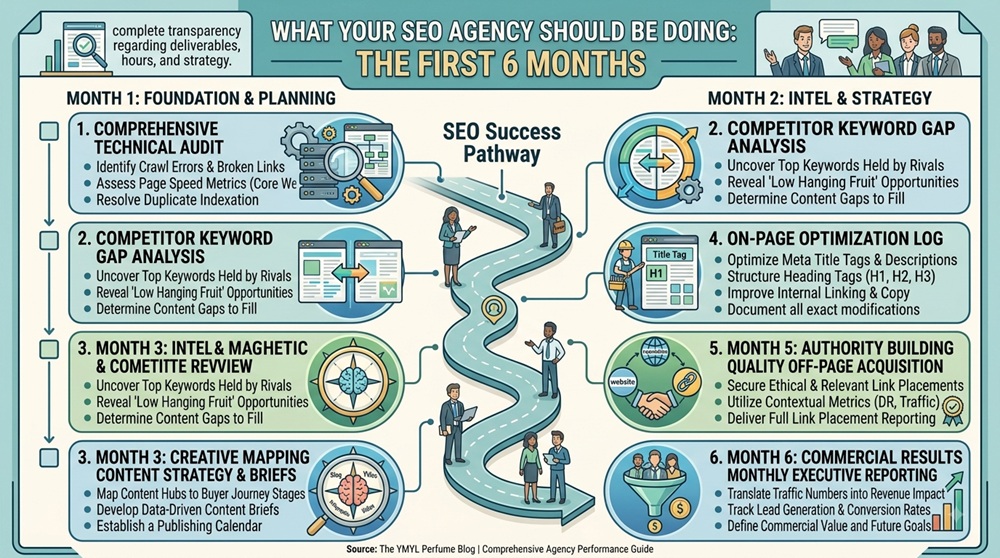
A professional agency should provide complete transparency regarding deliverables, hours, and strategy.
Essential Agency Deliverables Checklist
- [ ] Comprehensive Technical Audit: Identifying crawl errors, page speed metrics, and duplicate indexation paths.
- [ ] Competitor Keyword Gap Analysis: Uncovering exact keywords competitors rank for that you lack.
- [ ] Content Strategy & Briefs: Mapping content hubs directly to buyer journey stages.
- [ ] On-Page Optimization Log: Documenting exact title tag, heading, and copy modifications.
- [ ] Quality Off-Page Acquisition: Providing transparent link placement reporting with contextual metrics.
- [ ] Monthly Executive Reporting: Translating traffic numbers into commercial leads and revenue impact.
What Should Make You Question an SEO Agency?
Red Flag Warning Signs:
- Guaranteed Page-1 Rankings: No one controls Google’s live ranking algorithms. Guarantees often lead to black-hat manipulation or targeting zero-volume keywords.
- Vague Monthly Reports: Receiving PDF reports containing only generic ranking screenshots without explanations of actual work completed.
- Bulk Unvetted Backlinks: Claims of building “100+ backlinks per month” usually indicate automated spam or low-quality link farms that put your domain at risk of penalties.
- Total Focus on Blog Content: Ignoring high-intent commercial category pages while publishing endless generic blog posts that generate zero sales leads.
How Should You Measure SEO Success?
To evaluate whether your SEO investment is delivering real returns, track metrics across a three-tiered performance hierarchy:
| Metric Tier | Primary Focus | Key Performance Indicators (KPIs) |
| Tier 1: Business Impact | Direct Financial Return | Organic Revenue, Pipeline Value, Qualified Leads, Cost Per Acquisition (CPA) |
| Tier 2: Traffic Quality | Visitor Engagement | Non-Branded Organic Sessions, Conversion Rate (%), Key Page Views |
| Tier 3: Early Indicators | Algorithm Traction | Total Search Impressions, Keyword Position Velocity, Indexation Coverage |
Key Takeaways
- SEO Is Compounding: The work completed in months 1–3 lays the foundation for exponential growth in months 6–12.
- Starting Baselines Dictate Speed: Domain history, current technical health, and competitive saturation dictate early progress.
- E-E-A-T Builds Defensability: Demonstrating genuine human experience and original perspective protects rankings against future search updates.
- Focus on Business Metrics: Rankings are leading indicators, but sales, leads, and organic revenue determine real campaign success.
SEO FAQ
When will I see results from SEO?
Typically, you will see movement from SEO in search engine impressions and indexing within 60-90 days. SEO typically results in substantial traffic and lead growth between month 4 and month 6. For SEO to fully compound ROI most customers see results in 6-12 months.
Will SEO rank my website #1 on Google in 6 months?
If you are targeting ultra-competitive short-tail terms, the answer is no. SEO companies cannot realistically promise you #1 rankings for commercially valuable terms in less than a year, regardless of what they say. The algorithms used by search engines use hundreds of factors that change on a daily, if not real time basis.
Long-tail terms that are less competitive can often rank within the first page quickly.
How much traffic can I expect from SEO in 6 months?
If you currently have a robust traffic base and are sitting on an under optimized broken SEO architecture, you can likely expect to see increased organic traffic by 30%–80%.
If you are starting with a brand new domain, you can likely expect your organic traffic to increase from 0 to a few hundred targeted visitors a month within 6 months.
What happens if I don’t see any results from SEO in 6 months?
Ask for your SEO strategy to be reassessed. If you are not seeing any growth in impressions, keywords being displayed for, or organic traffic sessions within 6 months there are likely technical barriers to indexation, you’re targeting the wrong keywords based on search intent, or your brand simply does not have the domain authority it needs to rank.
Why does my competition with terrible websites rank above me?
There are many factors that go into search rankings. It is possible that your competition simply has a much higher domain trust level, far exceeds you in the number of quality backlinks, brand mentions (brand equity), and/or has had a website for significantly longer than you.


No comment