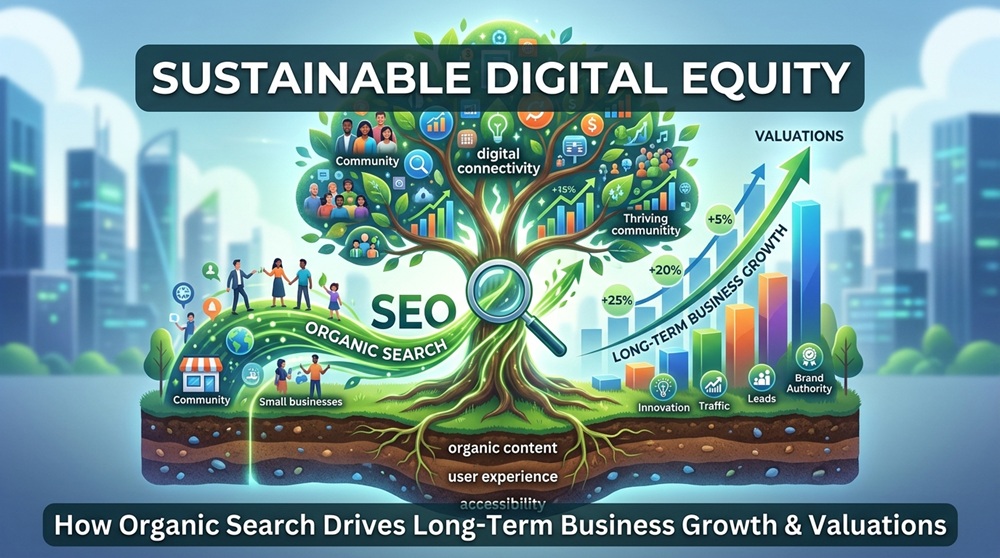
Organic search is a high-yield, compounding digital asset strategy that drives sustainable business growth, lowers customer acquisition costs (CAC), and builds long-term brand equity. Unlike paid channels (PPC) that cease operation when funding stops, search engine optimization (SEO) leverages technical infrastructure, topical authority, and search intent alignment to generate continuous pipeline. By establishing expertise, experience, authoritativeness, and trustworthiness (E-E-A-T), organizations capture high-intent buyers across the entire customer decision journey—from informational discovery to transactional conversion. This comprehensive guide details the strategic frameworks, economic models, and execution blueprints required to transform organic search from a simple traffic tactic into an enterprise balance-sheet asset.
Key Takeaways
- Compound Asset Growth: SEO acts as an equity investment rather than a rental expense, generating recurring traffic, leads, and sales long after initial production costs are amortized.
- Topical Authority Over Keyword Stuffing: Modern search algorithms prioritize depth across entire domain hubs (topic clusters) over isolated, keyword-dense individual pages.
- Full-Funnel Demand Capture: Sustainable strategies address every stage of the buyer journey—informational (awareness), commercial (consideration), and transactional (decision).
- Defensive CAC Cushion: Strong organic search positioning mitigates the risks of rising PPC cost-per-click (CPC) rates and third-party advertising dependencies.
- Technical & E-E-A-T Foundations: Search performance relies heavily on site architecture, Core Web Vitals, and verified subject-matter expertise (E-E-A-T signals).
- Revenue-First Attribution: Enterprise success is measured by pipeline value, customer lifetime value (LTV), and lower overall CAC, not merely surface-level rank tracking.
Table of Contents
Introduction: The Strategic Shift in Organic Search
The Economics: Organic Search vs. Paid Media
Mapping the Search Intent Matrix Across the Buyer Journey
Building Topical Authority: Strategic Frameworks
E-E-A-T as an Organizational Asset
Execution Models: Ecommerce vs. Service Businesses
Measuring Impact: Beyond Page-One Ranks
Common Enterprise Pitfalls & Strategic Correctives
Frequently Asked Questions
Conclusion
The Strategic Shift in Organic Search
For over two decades, search engine optimization was frequently compartmentalized as a tactical marketing activity—a checklist of metadata tweaks, keyword insertions, and link acquisition campaigns managed in isolation. In modern digital ecosystems, that reactive approach is ineffective. Organic search is now a fundamental core of sustainable business growth, directly impacting brand valuation, customer acquisition efficiency, and long-term market share.
Organizations operating in competitive markets face escalating customer acquisition costs (CAC) across paid advertising channels. Ad platforms operate on real-time bidding systems where click costs systematically rise alongside competition. Consequently, relying exclusively on performance marketing exposes margins to immediate risk.
Organic search provides a structural counterbalance. When executed as an enterprise strategy, organic search builds permanent digital assets: comprehensive topic hubs, authoritative domain reputations, and optimized user experiences that continue to attract, engage, and convert prospective customers independently of ongoing media spend.
The Economics: Organic Search vs. Paid Media
Understanding the strategic value of organic search requires analyzing its economic mechanics against paid channels (PPC, paid social, display).
Paid media functions as an operational rental model. You rent access to an audience provided by a platform publisher. The moment the capital allocation stops, traffic drops to zero immediately. While paid channels offer speed, predictability, and targeted scaling, they provide zero long-term enterprise equity.
Organic search functions as an asset-building model. Initial costs are concentrated in research, engineering, user experience (UX) design, and high-quality editorial production. Once published and ranked, these assets continue delivering value with minimal maintenance cost.
| Dimension | Paid Media (PPC / Paid Social) | Organic Search (SEO) |
| Financial Nature | Variable Operating Expense (OpEx) | Capital Investment / Compounding Asset |
| Time to Impact | Immediate (Hours/Days) | Medium-to-Long Term (Months) |
| Marginal Cost per Click | Flat to Increasing (Scale costs more) | Decreases toward Zero as rankings mature |
| Post-Budget Traffic | Drops immediately to zero | Persists; decays slowly without updates |
| Trust / Click-Through Rate | Subject to ad-blindness (~2–5% average CTR) | Higher inherent trust (~15–30%+ CTR for top positions) |
| Scalability Limit | Constrained by ad budget & auction clearing price | Constrained by search demand & domain authority |
| Strategic Advantage | Short-term testing, promotional bursts, quick data | Sustainable moat, defensive CAC, long-term valuation |
The Compounding Effect
The primary financial metric favoring organic search is its compounding return on investment (ROI). Consider an enterprise content hub costing R500,000 to develop. In Year 1, it may attract 50,000 qualified sessions, delivering an effective Cost Per Click (CPC) equivalent of R10.00. In Year 2, with minor technical maintenance, that same hub—having accumulated domain signals and internal links—attracts 150,000 sessions. The effective CPC drops to R3.33. By Year 3, traffic reaches 300,000 sessions, pushing the effective acquisition cost per visitor down to R1.66.
YEAR 1: [Development Investment] ---> 50,000 Sessions   (R10.00 Effective CPC)
YEAR 2: [Low Maintenance Cost]  ---> 150,000 Sessions  (R3.33 Effective CPC)
YEAR 3: [Optimization Pass]     ---> 300,000 Sessions  (R1.66 Effective CPC)
This compounding dynamic lowers an organization’s blended CAC over time, insulating business operating margins against rising advertising rates.
Mapping the Search Intent Matrix Across the Buyer Journey
Search engines serve as real-time intent databases. Every query entered represents an explicit user state, specific problem, or transactional requirement. High-performing organic search strategies map content architectures directly to these intent states across all stages of the buying process.
       [ AWARENESS STAGE ]
  Query: "Why is warehouse humidity too high?"
  Intent: Informational / Problem Recognition
              │
              ▼
     [ CONSIDERATION STAGE ]
  Query: "Industrial dehumidifier vs desiccant system"
  Intent: Commercial / Solution Evaluation
              │
              ▼
      [ DECISION STAGE ]
  Query: "Buy commercial desiccant dehumidifier enterprise"
  Intent: Transactional / Vendor Selection
1. The Awareness Stage (Informational Intent)
At this entry point, prospect inquiries are broad and problem-centric rather than brand-centric.
- Search Examples: “Why are warehouse heating costs escalating?”, “How to measure local search visibility”, “Symptoms of poor indoor air quality”.
- Content Strategy: Comprehensive guides, diagnostic tools, calculators, whitepapers, and diagnostic articles.
- Business Purpose: Capture prospects early in their research cycle, set the evaluation criteria for prospective solutions, and establish first-touch attribution.
2. The Consideration Stage (Commercial Intent)
Prospects have identified their specific problem and are actively evaluating candidate categories and vendor criteria.
- Search Examples: “Desiccant vs refrigerant industrial dehumidifier”, “Top enterprise SEO platforms comparison”, “In-house vs agency SEO cost analysis”.
- Content Strategy: Solution comparison matrices, feature teardowns, implementation guides, and unbiased evaluation frameworks.
- Business Purpose: Position the organization’s unique value proposition, influence decision criteria, and capture middle-of-funnel consideration shares.
3. The Decision Stage (Transactional Intent)
The prospect is prepared to select a provider or complete a purchase.
- Search Examples: “Commercial dehumidifier direct supplier South Africa”, “Hire B2B SEO strategist Cape Town”, “Enterprise CRM pricing quote ZAR”.
- Content Strategy: Optimized product landing pages, explicit service level pages, case studies, verified customer reviews, transparent pricing models, and direct contact gateways.
- Business Purpose: Maximize conversion rates, minimize friction, and convert high-intent traffic directly into qualified sales leads or revenue.
Building Topical Authority: Strategic Frameworks
Search engines no longer evaluate content in isolation. Modern natural language processing models evaluate a domain’s overall topical authority—its breadth, depth, and structural organization across an entire knowledge domain.
Attempting to rank a single standalone page for a high-value commercial query without supporting topical context is largely ineffective. Domains must demonstrate comprehensive knowledge across interconnected content networks known as Topic Clusters.
                 ┌────────────────────────────────┐
                 │          PILLAR PAGE           │
                 │ "Ultimate Industrial Drying    │
                 │        Solutions Guide"        │
                 └───────────────┬────────────────┘
                                 │
         ┌───────────────────────┼───────────────────────┐
         │                       │                       │
         ▼                       ▼                       ▼
┌─────────────────┐     ┌─────────────────┐     ┌─────────────────┐
│  CLUSTER PAGE   │     │  CLUSTER PAGE   │     │  CLUSTER PAGE   │
│ "Desiccant      │◀───▶│ "Warehouse      │◀───▶│ "Commercial     │
│ Dehumidifiers"  │     │ Humidity Control│     │ HVAC Sizing"    │
└─────────────────┘     └─────────────────┘     └─────────────────┘
The Hub-and-Spoke Architecture
- Pillar Page (Hub): A comprehensive, authoritative resource covering a broad topic at a high level (e.g., “The Complete Guide to Industrial HVAC Management”).
- Cluster Pages (Spokes): Highly detailed, subtopic-specific pages that dive deep into supporting concepts (e.g., “Calculated CFM Requirements for Warehouses”, “Desiccant Wheel Maintenance Standards”).
- Contextual Hyperlinking: Strategic, bidirectional internal linking connects all cluster pages back to the pillar page using descriptive anchor text.
This structural architecture signals to search engine crawlers that the domain possesses structured expertise across the entire subject matter, elevating ranks across all pages within the cluster simultaneously.
E-E-A-T as an Organizational Asset
Google’s Quality Rater Guidelines emphasize E-E-A-T: Experience, Expertise, Authoritativeness, and Trustworthiness. While E-E-A-T is an evaluation framework rather than a singular direct ranking algorithm, the signals that inform it directly correlate with search visibility and user conversion performance.
Practical Signals of Real-World E-E-A-T
  [ EXPERIENCE ]  ──► First-hand usage, original photos, unique process logs.
  [ EXPERTISE ]   ──► Credentialed authors, technical accuracy, peer reviews.
  [ AUTHORITY ]   ──► Recognized industry citations, external brand mentions.
[ TRUST ] ──► Transparent business data, secure UX, clear policies.- Documented First-Hand Experience: Including original methodology photos, primary operational research, custom data sets, and documented field insights that generic, automated summaries cannot replicate.
- Verified Author Attribution: Author bio sections detailing real-world professional backgrounds, industry certifications, publications, and personal LinkedIn/social profiles.
- Transparent Business Operations: Clear accessibility to privacy policies, terms of service, editorial guidelines, executive leadership profiles, physical business address details, and direct support channels.
- External Validation: Contextual references, press mentions, professional accreditations, client testimonials, and industry association memberships.
Organizing digital assets to clearly present these signals protects domains against algorithmic updates aimed at surfacing higher-quality results.
Execution Models: Ecommerce vs. Service Businesses
While the underlying mechanics of indexing and technical optimization remain constant across all web architectures, the strategic execution of organic search differs radically between Ecommerce storefronts and Service/B2B organizations. Each model demands distinct site architectures, keyword targeting methodologies, content frameworks, and conversion funnels.
Organic search drives 43% of all ecommerce traffic and generates 23.6% of online orders, highlighting why ecommerce platforms require strict transactional keyword targeting and product-first architectures compared to service and B2B organizations
┌─────────────────────────────────────────────────────────────────────────┐
│                          ECOMMERCE EXECUTION                            │
│  Scale & Taxonomy Focus ➔ Programmatic SEO ➔ Faceted Navigation         │
│  Primary Goal: Direct On-Site Transactions & High Cart Value            │
└─────────────────────────────────────────────────────────────────────────┘

┌─────────────────────────────────────────────────────────────────────────┐
│                        SERVICE / B2B EXECUTION                          │
│  Trust & Depth Focus ➔ Thought Leadership ➔ Intent-Driven Landing Pages │
│  Primary Goal: Lead Qualification, Consultations & High-Contract LTV   │
└─────────────────────────────────────────────────────────────────────────┘
1. Ecommerce Growth Blueprint
Ecommerce SEO operates at the intersection of inventory scale, site taxonomy, and UX speed. The target buyer is searching with high commercial intent for specific physical items, category breadth, or immediate price comparisons.
A. Category Pages as Strategic Revenue Hubs
In ecommerce, product category pages (and sub-category pages) consistently capture higher search volume and drive more recurring revenue than individual product URLs (SKUs).
- Tactical Execution: Rather than treating category pages as empty product grids, engineer them as authoritative landing pages. Integrate short, intent-focused buyers’ guidance (150–300 words) above the fold, followed by dynamic filter controls, dynamic FAQ accordions addressing shipping/warranty questions at the bottom, and internal links pointing to related sub-categories.
- Taxonomy Alignment: Map URLs to clear consumer searching mental models (e.g.,
/heating/dehumidifiers/industrial-desiccant/rather than generic parameters like/products?cat=492).
B. Programmatic Optimization & Faceted Navigation Management
Large inventory catalogs generate thousands of URL combinations through search filters (color, size, price, brand). Uncontrolled faceted navigation leads to indexation bloat, duplicate content penalties, and severe crawl budget dilution.
- Tactical Execution: Enforce strict canonicalization strategy. Canonicalize filtered variation pages back to the clean parent category URL unless a specific filter combination carries substantial search volume (e.g., “Men’s Black Leather Jackets”). For low-demand parameter combinations, deploy
noindex, followdirectives or manage facet crawling via server-side logic and robots.txt constraints.
C. Rich Data Schema & SKU Enhancements
Transactional buyers rely heavily on visual SERP features (price, stock availability, star ratings, shipping costs) before ever clicking a search link.
- Tactical Execution: Implement complete
Product,Offer,AggregateRating, andMerchantReturnPolicystructured data scripts across every product template. This ensures rich snippet eligibility in Google Search and Google Shopping tabs, significantly improving organic click-through rates (CTR).
D. Content-Led Commerce (Buying Guides & Comparisons)
Ecommerce customers frequently search for pre-purchase validation before selecting a specific model.
- Tactical Execution: Build a dedicated resource hub featuring buying guides, sizing tools, care instructions, and direct product comparison matrices (e.g., “Top 5 Commercial Dehumidifiers for Warehouses (2026 Comparison)”). Insert contextual product cards and direct “Add to Cart” triggers within these informational guides to bridge the gap between intent and purchase.
2. Service & B2B Growth Blueprint
Service-based and B2B organizations operate in high-friction, long-sales-cycle environments with elevated Customer Lifetime Values (LTV). Organic search strategy here is not about mass catalog traffic; it is about reaching key decision-makers, building corporate credibility, and capturing high-intent inquiries.
A. Dedicated Solution & Industry-Specific Landing Pages
B2B buyers rarely convert on generic “Our Services” overview pages. They search for highly specific solutions tailored to their industry vertical, regional compliance needs, or operational scale.
- Tactical Execution: Build an interconnected service architecture. For an accounting firm, create individual service pages for “Tax Structuring” and “Corporate Auditing”, and branch into industry vertical pages like “Tax Structuring for Tech Startups” or “Auditing for Logistics Companies”. Tailor value propositions, case studies, and terminology directly to the specific vertical target.
B. Bottom-of-Funnel (BOFU) Comparison & Alternative Pages
B2B prospects actively evaluate competing vendors late in the buyer journey using explicit brand queries (e.g., “Vendor A vs Vendor B” or “Competitor X Alternatives”).
- Tactical Execution: Publish objective, highly accurate comparison landing pages and alternative guides on your own domain (e.g., “Why Enterprise Clients Choose [Our Brand] Over [Competitor]”). Present fair feature-by-feature comparison matrices, verified client testimonials, and transparent pricing structures. Owning these search results prevents competitors and third-party review sites from dictating your brand’s narrative.
C. Proof-Driven Content & Thought Leadership Hubs
B2B contracts carry significant organizational risk for the buyer. Consequently, content must demonstrate institutional expertise, compliance readiness, and proven track records.
- Tactical Execution: Embed contextual proof points throughout all core copy: embed downloadable client case studies with verified ROI figures, showcase industry certifications, feature direct executive quotes, and link to peer-reviewed whitepapers or original industry research.
D. Frictionless Conversion Funnels & Lead Qualification
Service businesses need to capture and qualify prospective leads efficiently without introducing unnecessary drop-off points.
- Tactical Execution: Align lead generation mechanics to intent depth. Offer simple consultation booking widgets, live chat, or direct quote forms on high-intent transactional service pages. Reserve gated assets (e.g., full industry reports, custom financial spreadsheets) for top-of-funnel informational content where visitors are still early in the evaluation process.
Measuring Impact: Beyond Page-One Ranks
Tracking keyword ranks alone yields an incomplete picture of business success. Enterprise search strategies measure metrics tied directly to balance-sheet results.
       TACTICAL METRICS                 STRATEGIC METRICS
┌─────────────────────────────┐   ┌─────────────────────────────┐
│ • Keyword Rankings          │   │ • Organic Revenue & Margin  │
│ • Total Impressions         │   │ • Qualified Pipeline Value  │
│ • Raw Organic Sessions      │   │ • Customer Acquisition Cost │
│ • Page-Level Indexation     │   │ • Blended CAC Reduction     │
└─────────────────────────────┘   └─────────────────────────────┘
               │                                 │
               └───────────────┬─────────────────┘
                               │
                               ▼
               [ BALANCED ENTERPRISE DASHBOARD ]
Essential Organic Search Metric Framework
- Pipeline & Revenue Attribution: Measuring exact conversions, sales-qualified leads (SQLs), and total revenue generated by visitors entering via organic landing pages.
- Customer Acquisition Cost (CAC) Trends: Tracking how growing organic traffic volumes reduce total blended CAC across all acquisition channels over multi-quarter periods.
- Share of Search Voice: Evaluating the percentage of top-of-funnel and bottom-of-funnel queries your brand controls compared to direct competitors within your market segment.
- Content Efficiency Rate: Tracking the percentage of published URLs that actively generate non-branded impressions, clicks, and conversion events.
Common Enterprise Pitfalls & Strategic Correctives
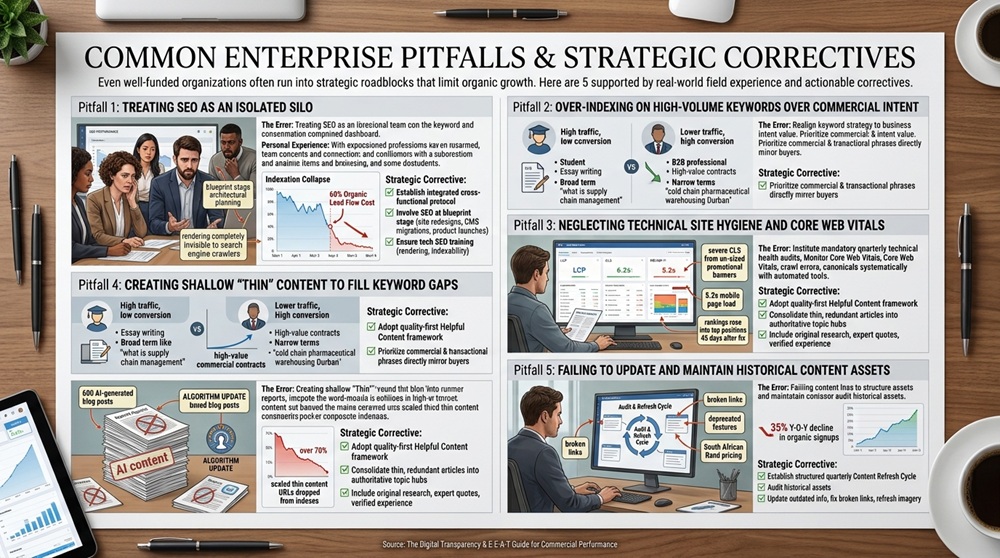
Even well-funded organizations often run into strategic roadblocks that limit organic growth. Below are 5 common enterprise pitfalls, supported by real-world field experience and actionable correctives.
Pitfall 1: Treating SEO as an Isolated Marketing Silo
- The Error: Compartmentalizing the organic search team away from software engineers, product designers, PR specialists, and sales directors.
- Personal Experience: I once audited a large enterprise organization that spent over R1,200,000 across nine months building a sophisticated custom JavaScript web platform. Because the SEO advisory team was omitted from the architectural planning, the engineering team deployed a client-side rendering setup that rendered site content completely invisible to search engine crawlers. Indexation collapsed overnight, costing the firm nearly 60% of its organic lead flow within six weeks post-launch.
Strategic Corrective: Establish an integrated cross-functional protocol. Involve SEO strategists at the blueprint stage of all site redesigns, CMS migrations, product launches, and brand campaigns. Ensure software developers receive technical SEO training covering indexability and rendering.
Pitfall 2: Over-Indexing on High-Volume Keywords Over Commercial Intent
- The Error: Prioritizing generic top-of-funnel search terms solely because they carry massive search volumes, while ignoring lower-volume, high-converting queries.
- Personal Experience: During a consulting engagement with a specialized B2B logistics firm, the client spent two years aggressively ranking #1 for the broad search term “what is supply chain management”. The page generated over 100,000 monthly visits, but 98% of those visitors were university students writing essays. The page produced virtually zero qualified commercial leads. Meanwhile, competitors dominated lower-volume queries like “cold chain pharmaceutical warehousing Durban”, capturing high-value commercial contracts.
Strategic Corrective: Realign keyword strategy around business intent value rather than vanity search volume. Prioritize commercial and transactional phrases that directly mirror the prospective client’s buying state, even if monthly search volumes appear low.
Pitfall 3: Neglecting Technical Site Hygiene and Core Web Vitals
- The Error: Publishing volume editorial content while ignoring fundamental technical health, server performance, and page experience signals.
- Personal Experience: Working with an enterprise ecommerce brand managing over 40,000 SKUs, the marketing team complained that new product category pages were failing to reach page one despite publishing thorough buying guides. A technical audit revealed a severe Cumulative Layout Shift (CLS) caused by un-sized promotional banners and slow third-party ad tags, alongside average page load times exceeding 5.2 seconds on mobile devices. After addressing image dimensions, optimizing script loads, and resolving core technical bottlenecks, existing category page rankings rose into top positions within 45 days without writing a single new word of copy.
Strategic Corrective: Institute mandatory quarterly technical health audits. Monitor Core Web Vitals (Largest Contentful Paint, Interaction to Next Paint, Cumulative Layout Shift), crawl errors, canonical consistency, and mobile responsiveness systematically using automated monitoring tools.
Pitfall 4: Creating Shallow “Thin” Content to Fill Keyword Gaps
- The Error: Mass-producing low-value, generic 500-word articles created to target keyword variations without providing genuine depth, unique insights, or original perspective.
- Personal Experience: I reviewed a financial services domain that published over 600 generic, AI-generated blog posts within a four-month period in an attempt to capture every financial keyword variation. When search algorithms updated to reward genuine helpfulness and original expertise, search engines flagged the domain as scaled thin content. Over 70% of the site’s URLs were dropped from search indexes, dragging down the domain’s organic footprint across its primary financial service offerings.
Strategic Corrective: Adopt a quality-first “Helpful Content” editorial framework. Consolidate thin, redundant articles into comprehensive, authoritative topic hubs. Include original research, direct expert quotes, custom graphics, and verified operational experience within every published piece.
Pitfall 5: Failing to Update and Maintain Historical Content Assets
- The Error: Treating published articles and landing pages as static “set and forget” tasks, allowing information, statistics, internal links, and technical recommendations to decay.
- Personal Experience: A SaaS client observed a steady 35% year-over-year decline in organic signups despite continuously publishing fresh blog content. A content audit revealed that their primary revenue-generating pillar guide—originally published three years prior—contained broken external links, outdated interface screenshots, deprecated product features, and obsolete pricing in South African Rand. Competitors had published fresher resources and captured top search positions. We conducted a comprehensive content refresh, updated statistics, added modern visual examples, and re-optimised internal link paths. Within 60 days, traffic rebounded by 110%, restoring qualified trial signups.
Strategic Corrective: Establish a structured quarterly Content Refresh Cycle. Audit historical content assets regularly. Update out-of-date information, fix broken links, refresh imagery, improve internal links, and re-align content structures to answer changing user needs.
Frequently Asked Questions
How long does organic search take to generate measurable business results?
While minor technical fixes and page optimizations can yield positive movement in 60 to 90 days, substantial organic traffic and revenue growth typically require 6 to 12 months of consistent execution. Timelines depend heavily on existing domain authority, technical health, resource allocation, and competitive intensity in the target niche.
How does organic search lower overall Customer Acquisition Costs (CAC)?
Unlike paid channels where every click incurs a marginal cost, organic search traffic scales without a direct linear increase in ad spend. As organic content ranks and traffic compounds over time, the fixed investment in content creation and technical SEO spreads across an increasing volume of visitors and conversions, bringing down the company’s overall blended CAC.
What is the practical difference between keyword research and intent research?
Keyword research identifies the specific words, phrases, and search volumes users enter into search engines. Intent research analyzes why the user is searching—determining whether they want to learn a concept, compare competing solutions, or make an immediate purchase. Effective strategy aligns content structure to satisfy the underlying intent behind the query.
Can enterprise B2B organizations with long sales cycles benefit from organic search?
Yes. B2B buying committees perform extensive research before reaching out to sales teams. By publishing authoritative comparison guides, technical specification hubs, compliance documentation, and ROI frameworks, B2B companies influence buyer requirements early in the research process and build brand preference well before direct contact occurs.
Why is topical authority more effective than optimizing individual keywords?
Search algorithms evaluate content contextually across entire domain spaces. A site that builds deep, interconnected content hubs covering a primary topic and all its supporting subtopics demonstrates structural expertise. This enables pages across the domain to rank higher and recover faster from algorithmic updates than sites featuring disconnected articles.
How should businesses manage organic search content updates over time?
Existing content should be systematically audited on a 6-to-12-month cadence. High-performing assets should be refreshed with updated data, modern examples, improved internal links, and expanded answers to emerging user queries. Content pruning or consolidation should be applied to underperforming or redundant pages to preserve crawl efficiency and domain focus.
Conclusion
Organic search is a fundamental digital growth engine. While paid channels offer immediate operational speed, organic search builds lasting market visibility, sustainable enterprise value, and a reliable stream of qualified prospective customers.
By committing to a strategy built around technical excellence, clear intent mapping, topical depth, and verified E-E-A-T signals, organizations establish a self-reinforcing growth asset. Over time, this digital moat reduces channel dependency, cushions profit margins against rising ad costs, and drives business growth year after year.
Ready to Build Lasting Digital Equity with EcoSEO?
Paid channels only work while you fuel them. At EcoSEO, we help forward-thinking businesses build self-reinforcing organic assets that lower blended acquisition costs and drive continuous pipeline over time.
- ✓ Audit Intent Gaps: Identify high-value commercial queries competitors missed.
- ✓ Strengthen Technical Core: Eliminate site speed, Core Web Vitals & indexing bottlenecks.
- ✓ Scale Topical Hubs: Build interconnected content that establishes domain authority.



No comment